

Infectious mononucleosis PCR panel
150.00€
Cytomegalovirus PCR detection
132.00€
Epstein–Barr virus PCR detection
132.00€

Infectious mononucleosis is an infectious disease of the reticuloendothelial and lymphatic systems caused by a virus. Infectious mononucleosis is also known as “the kissing disease”.
In 90% of cases, mononucleosis is caused by the Epstein – Barr virus (EBV), a member of the herpesvirus group. Most remaining cases are caused by other herpesviruses, particularly cytomegalovirus (CMV). EBV spreads through the saliva of an infected person. Kissing and contact with hands or toys covered in infected saliva are common ways the virus spreads.
EBV is found in the saliva of an infected person and continues to be shed in saliva for up to a year after infection. After the initial infection, the virus remains in the host for life and may occasionally reactivate and be shed from the throat and pharynx.
The disease is characterised by symptoms appearing four to six weeks after exposure. These include symptoms such as:
Because diseases caused by EBV and CMV have similar symptoms, Poliklinika Analiza has introduced infectious mononucleosis diagnostics.
Split
Dugopolje
Zadar
Šibenik
021 688 888
Zagreb
Varaždin
01 2099 880
Rijeka
051 309 309
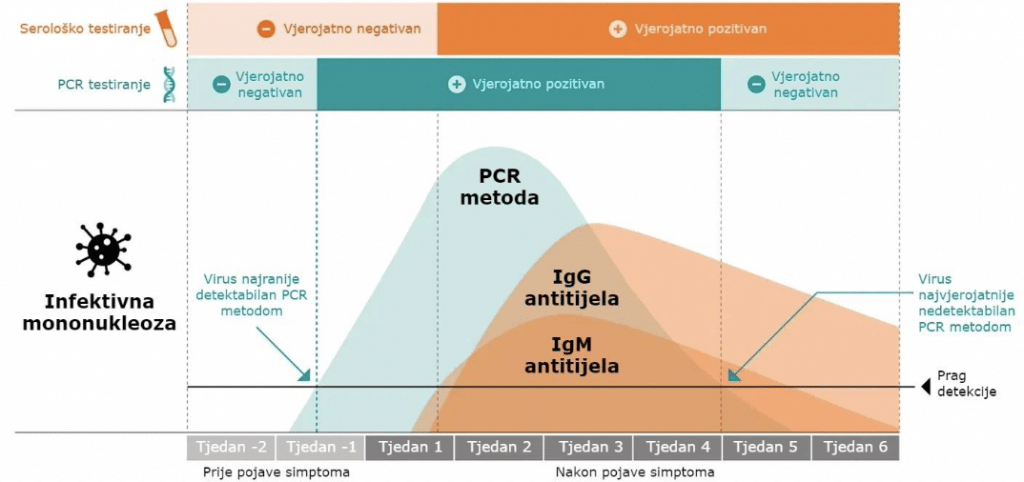
When the first symptoms appear, it is usually possible to detect the pathogen, but rarely the antibodies. During recovery, it is rarely possible to detect the pathogen, but antibodies can be detected.
The best and most effective way to use these tests is in tandem. Since PCR and serological testing have different advantages and limitations, using both methods where appropriate will probably give us the best and most comprehensive results. Contact us and arrange testing for yourself and your loved ones in time!
Contact us for free consultations.
Rijeka
Zadar